
China on Monday successfully test-fired a long-range strategic missile from one of its nuclear-powered submarines in the Pacific Ocean, drawing sharp reactions from Japan and Australia.

Chinese Foreign Minister Li Zhaoxing said his country was always committed to maintaining peace in the world and outer space.

Successful interceptor, anti-ship, MIRV and hypersonic technology tests have strengthened India's position among a select group of advanced missile powers.

Three milestones in three days signal India's growing mastery in next-generation strategic technologies spanning nuclear deterrence, hypersonic propulsion and precision stand-off strike capability.

Vladimir Putin on Wednesday said that Russia has successfully tested a nuclear-powered submersible drone with unlimited range.
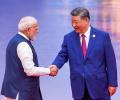
India's dual pursuit of a robust strategic partnership with Washington and a pragmatic, tension-management policy with Beijing represents the essence of modern multi-alignment. By embracing economic pragmatism, learning to compartmentalize political differences, and engaging in continuous dialogue, India can secure its borders, grow its economy, and contribute to a stable, multipolar Asian century, points out Ambassador Rajasekhar.

It is not clear whether India will go ahead with the plan for the missile test in view of the presence of the Chinese spy ship.

For the foreseeable future, the most likely outcome remains continuation of the status quo. Taiwan will remain self-governing without formally declaring independence, while China continues to apply sustained pressure short of war, predict Krishnan Srinivasan and Manoj Mohanka.

India is increasingly focusing on long-range weapons capable of reaching targets across China.

China has confirmed providing on-site technical support to Pakistan during last year's conflict with India, according to official media reports.

India successfully test-fired the newly-developed tactical missile Pralay, capable of carrying conventional warheads, from APJ Abdul Kalam island off the coast of Odisha. The missile, developed by DRDO, has a range of 150 to 500 km and a payload capacity of 500-1,000 kg.
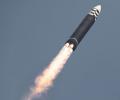
This is the first time in decades that China has made its flight test of an intercontinental ballistic missile public in an apparent show of strategic deterrence, State-run China Daily reported.

Delhi must now purge the delusional hopes of being a 'counterweight' to China in the US calculus, argues Ambassador M K Bhadrakumar.

A lesson for India is to clearly define objectives beforehand, so that the adversary or other parties do not attempt to mitigate them midway.

'We caught General Pervez Musharraf talking over the phone with his Chief of General Staff Lieutenant General Mohammad Aziz. Musharraf was visiting China; Aziz was in Rawalpindi.'

Reacting to the recent supersonic interceptor missile test by India, Sartaj Aziz, Pakistan Prime Minister's adviser on Foreign Affairs, has said that Islamabad will acquire advanced technology to improve its defence and will also raise the matter at the international arena.

Pakistan and China are among the countries which are testing nuclear weapons, United States President Donald Trump has said to justify his administration's plans to resume testing of the US's own nuclear assets after a gap of over three decades.

India successfully test-fired the 'Agni 5' intermediate range ballistic missile, capable of reaching targets up to 5,000 km, validating its operational and technical parameters.
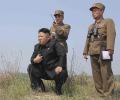
The missile was launched at 23:41 North Korea time from Jagang province in the north of the country, South Korean news agency Yonhap reported.

'We were in a heavily nuclearised environment. China had tested for Pakistan in the 1980s and helped their missile programme stay just one step behind us.'

India has successfully test-fired a long range hypersonic missile from the APJ Abdul Kalam Island off the coast of Odisha, Defence Minister Rajnath Singh said on Sunday.

The ballistic missile launch was the first by Iran since Trump became President.

'Pakistan's is the only military-controlled nuclear weapons programme in the world.' 'As people get radicalised, the risk of a brigadier or pilot taking matters into their own hands is a real concern.'

The purge in Washington does not pause the war. Strikes continue, Hormuz remains closed, and Brent crude is still dancing around $109 a barrel. For India, the command chaos in the Pentagon is another layer of uncertainty piled on five weeks of conflict that was already straining every buffer Delhi has.

US President Donald Trump threatened to bomb Iran if a deal is not reached before the ceasefire ends, while Pakistan urged both sides to extend the truce and pursue diplomacy.

The Chinese military on Monday started new major drills in the 'middle areas' of the Taiwan Strait amid rising diplomatic tensions with Japan over Taiwan that Beijing claims as its territory.

The LPG squeeze on India's restaurant sector is the quotidian face of a deeper crisis.

North Korea on Friday launched an ICBM for the second time in a month.

China has said that it successfully carried out a land-based mid-course anti-ballistic missile (ABM) technical test on Sunday with Chinese experts claiming that the tests, stated to be the sixth of its kind, validated the reliability of the country's anti-ballistic missile umbrella.

The ceasefire is still technically holding, to the extent that no overt hostilities have been reported yet, but the rhetoric has hardened dangerously. The week ahead will also clarify whether the Islamabad failure was a negotiating tactic or whether Washington has genuinely locked itself into a position from which the only exits are climb-down, escalation, or the slow bleed of a new status quo that nobody chose and nobody controls. Prem Panicker continues his must read blog on the Iran War.
Hundreds of Formula One team personnel are stranded in Bahrain after airspace closures triggered by Middle East conflict, but Australian GP chief Travis Auld says Melbourne's season-opener will not be affected.
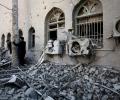
The logic of war plus the gathering storms in US politics as the midterms loom large leave him with no real alternative but to negotiate, points out Ambassador M K Bhadrakumar.

The 'rescue' operation occurred within kilometres of Iran's underground tunnel complex at Isfahan, assessed by the IAEA and US intelligence as holding a substantial portion of the country's 60 per cent enriched uranium stockpile. Retired senior US military officers have highlighted that the mission's footprint -- hundreds of special operators, multiple heavy-lift aircraft deep inside Iran -- appears outsized for recovering a single airman. Prem Panicker continues his must read blog on the Iran War.

China displayed a range of new weapons at a military parade, including laser weapons, nuclear ballistic missiles, giant underwater drones, and fifth-generation aircraft.
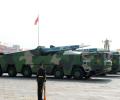
China might one day be able to launch a surprise nuclear attack on the United States, the second highest-ranking American military officer has warned as he shed new details of Beijing's hypersonic weapons test in July, which sent a missile around the world at more than five times the speed of sound.
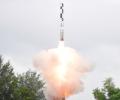
India has already deployed a sizeable number of the original BrahMos missiles and other key assets in several strategic locations along the de-facto border with China in Ladakh and Arunachal Pradesh.

However, Kim gave no indication of Pyongyang willing to give up its nuclear weapons

In the Indo-Pacific's new era -- where perception shapes reality faster than treaties -- the real entrapment is not of China or the United States. It is the test Japan has set for itself -- and whether partners like India, acting as balancers rather than accelerants, can help ensure that the story ends in stability, points out Varun Arya.

Iran is fighting a different war: Older, slower, and in some ways more dangerous. Iran doesn't need to shoot down an F/A-18. It only needs to make the Strait of Hormuz feel dangerous long enough for insurance markets, shipping companies, and oil futures traders to do the rest. Prem Panicker continues his must-read daily blog on the war in the Middle East.
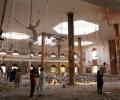
In 2025, India launched Operation Sindoor, a multi-domain combat mission against Pakistan in response to cross-border terrorism. The operation involved precision strikes, military retaliation, and diplomatic measures, marking a significant shift in India's security policy.
